
The key to sounding like a native Italian speaker
Reading time: 7 minutes
Ciao! 👋
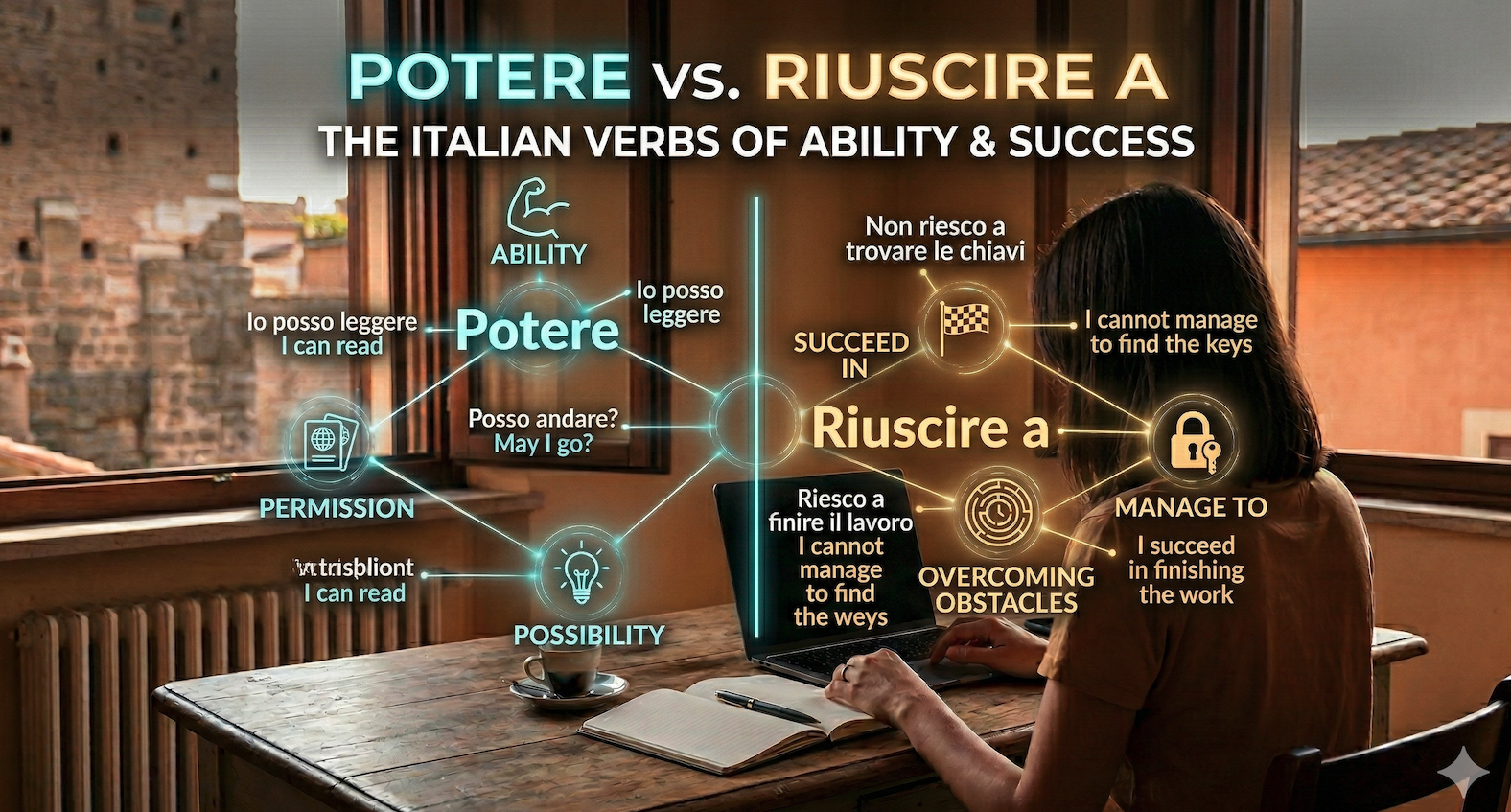
In the Italian language, the verbs potere and riuscire (a) both translate to “can” or “to be able to” in English. Because of this, they are easily confused by students!
However, they carry distinct nuances and are used in very different contexts. Understanding when to use one over the other is a huge step toward sounding like a native Italian speaker. Let’s explore these differences to master the subtleties of Italian.
📖 Table of Contents
1. Potere: The Verb of Possibility and Permission
What you are allowed to do, or what circumstances make possible
Potere is a versatile modal verb that primarily deals with the concepts of circumstantial possibility and permission. It’s used to express what you are allowed to do, or what is possible based on external factors (like time, rules, or availability).
“Potere” is followed directly by an infinitive verb, without any prepositions.
🇮🇹 “Mamma, posso andare alla festa stasera?”
🇬🇧 “Mom, can I go to the party tonight?”
Here, you are asking for permission from an authority figure.
🇮🇹 “Oggi non posso uscire, devo studiare per l’esame.”
🇬🇧 “I can’t go out today, I have to study for the exam.”
You have the physical ability to go out, but external circumstances — having to study — prevent you.
2. Riuscire (a): The Verb of Personal Capability
“To manage to” or “to succeed in” — when it’s about YOU
On the other hand, riuscire is about an individual’s physical or mental ability to accomplish something, often overcoming an obstacle. It’s akin to saying “to manage to” or “to succeed in” in English.
“Riuscire” MUST be followed by the preposition “a” before the next infinitive verb → Riuscire a + infinitive.
🇮🇹 “Non riesco a sbloccare il mio telefono.”
🇬🇧 “I can’t manage to unlock my phone.”
It’s not about permission; you literally lack the physical ability or the passcode to do it.
🇮🇹 “Dopo un’ora di ricerca, sono riuscito a trovare le chiavi!”
🇬🇧 “After an hour of searching, I managed to find the keys!”
You successfully completed a challenging action.
3. When “Potere” and “Riuscire” Overlap
Same sentence, completely different meaning!
The overlap between potere and riuscire often occurs in situations where an action fails. Both verbs can be used in the same sentence, but they completely change the meaning of why the action isn’t happening!
Let’s look at three common scenarios to see the difference:
🇮🇹 “Non posso preparare la cena.”
➡️ I don’t have time, I’m not at home, or I don’t have the ingredients. (External factors)
🇮🇹 “Non riesco a preparare la cena.”
➡️ The recipe is too complicated for my cooking skills, or I burned everything! (Personal difficulty)
🇮🇹 “Non posso risolvere il problema.”
➡️ I am not authorized to fix this, or I don’t have the right tools. (External limitation)
🇮🇹 “Non riesco a risolvere il problema.”
➡️ I don’t understand the math, it’s too difficult for my brain to grasp. (Lack of capability)
🇮🇹 “Non posso correre.”
➡️ The doctor strictly advised against it, or I am wearing high heels. (External restriction)
🇮🇹 “Non riesco a correre.”
➡️ My legs hurt, I am out of breath, or I lack the stamina. (Physical limitation)
Understanding the distinction between potere and riuscire is crucial for speaking Italian accurately. Remember: Potere is about external factors and permissions, while Riuscire is about internal capabilities and managing to do something.
Keep practicing, and you’ll soon be able to navigate these verbs with ease! 💪
Alla prossima! 👋
Rispondi