
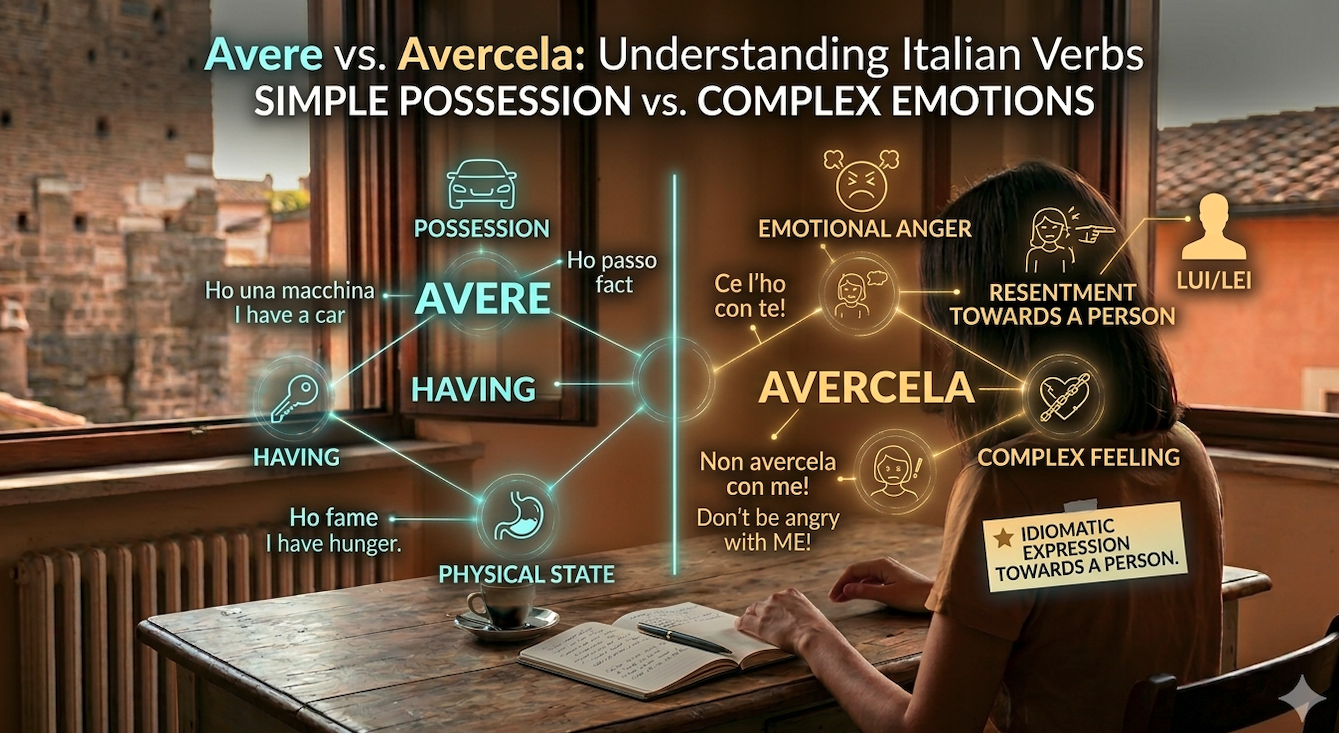
Two verbs that look similar but mean completely different things
Bentornati! 👋
I have decided to write this post because some students, during my Italian lessons on italki, often ask me a very specific question: “What is the exact difference between the verb avere and the verb avercela?”
I want to clarify this issue in a simple and direct way, without going into too much overwhelming grammar detail. Here is a clear explanation with practical examples that will help you understand the difference between these two verbs. They may look similar, but they have completely distinct meanings!
📖 Table of Contents
1. Avere
To have — possession, needs and sensations
The verb avere is one of the most used verbs in the Italian language and has multiple meanings. In general, it indicates possession or control of something or someone.
- “Io ho una macchina nuova.”(I have a new car.)
- “Loro hanno una casa bellissima.”(They have a beautiful house.)
- “Tu hai due fratelli.”(You have two brothers.)
In Italian, avere is also used to express physical sensations or needs, where English typically uses the verb “to be”.
- “Ho fame / Ho sete.”(I am hungry / I am thirsty — Literally: I have hunger/thirst.)
- “Hai freddo?”(Are you cold? — Literally: Do you have cold?)
- “Marco ha 30 anni.”(Marco is 30 years old — Literally: Marco has 30 years.)
You can read more about why Italians use “to have” instead of “to be” for needs and sensations in my dedicated article!
2. Avercela
To be mad at / to have a grudge — anger and frustration
The pronominal verb avercela is extremely common in spoken Italian, but unlike simple avere, it has a very specific, emotional meaning.
Essentially, it indicates an emotion of challenge, frustration, anger, or resentment towards something or someone. It is the Italian equivalent of saying “to be mad at someone” or “to have it out for someone.”
Combine the pronoun ce, the pronoun la (which drops its vowel and becomes l’), and the verb avere:
io ce l’ho · tu ce l’hai · lui/lei ce l’ha · noi ce l’abbiamo · voi ce l’avete · loro ce l’hanno
- “Perché non mi parli? Ce l’hai con me?”(Why aren’t you talking to me? Are you mad at me?)
- “Non avercela con lui, non l’ha fatto apposta!”(Don’t be mad at him, he didn’t do it on purpose!)
- “Sono arrabbiata, ma non ce l’ho con te.”(I am angry, but I’m not mad at you.)
In practice, avercela is used to express an emotional reaction to a negative or unpleasant situation, such as when one feels unfairly treated or undervalued.
I hope, as always, that this post has been helpful to you! If you want to practice a bit of Italian with me, or if you have any further questions or feedback, you can book a lesson on my italki profile here. 🤗
Alla prossima! 👋
📄 Free PDF Summary & Exercises
I often come across interesting articles that I know I’ll want to revisit later, so I either print them out or save them to my iPad, as I find it inconvenient to read grammar rules on a computer screen. If you feel the same way, I’ve provided a free PDF Summary Table of this article, along with a worksheet containing practical exercises (with answers), so you can practice using avere and avercela right away!
Rispondi