
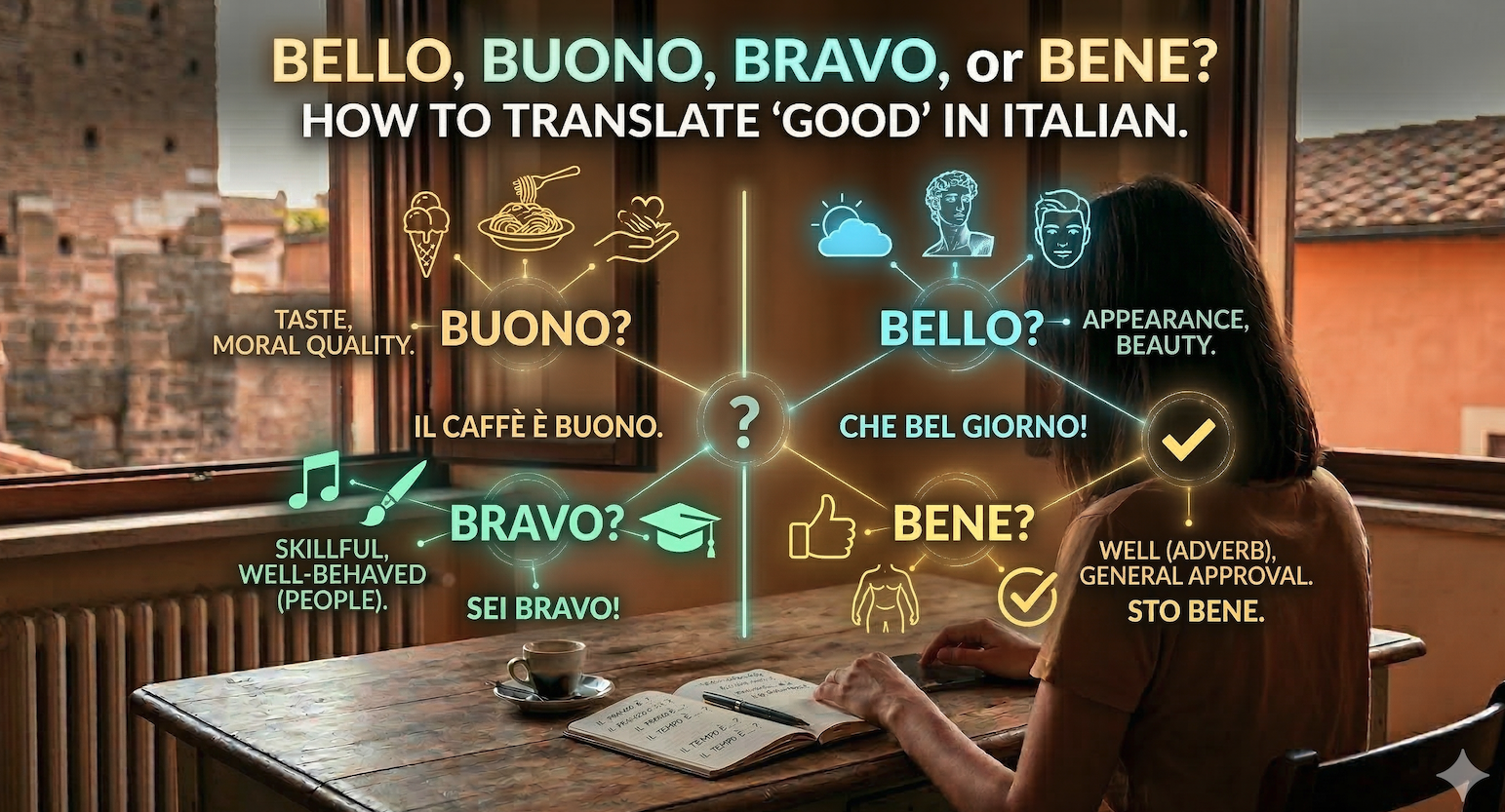
Four words where English has only one
Ciao! 👋
Are you ready to discover the differences between the word “good” in English and the words bene, bravo, buono and bello in Italian?
I know it may be a bit confusing at first. In English, you can use “good” for almost everything — a good boy, a good pizza, a good movie, doing good. But in Italian, we use four different words depending on the exact context!
In this article, I will show you the differences in a simple and clear way, with practical examples to demonstrate how to use each one correctly. Keep reading!
📖 Table of Contents
1. Good vs. Bello
Aesthetics — beautiful, handsome, nice-looking
Bello indicates the aesthetic aspect of someone or something. It is the equivalent of beautiful, handsome or nice-looking. Its exact opposite is brutto (ugly).
Since it is an adjective, it must agree in gender and number with the person or object it refers to: bello, bella, belli, belle.
- “Che bel panorama!”(What a beautiful view!)
- “Marco è un bel ragazzo.”(Marco is a handsome boy.)
- To intensify a concept (positive or negative): “Abbiamo un bel problema.”(We have a big problem.)
- To intensify (negative result): “Ho preso una bella fregatura!”(I got a good/big rip-off!)
- For irony: “Ah, bella scusa!”(Ah, nice excuse! — meaning it’s a terrible excuse.)
2. Good vs. Buono
Quality, taste & kindness
Buono is used to describe the positive quality of an object, the taste of food, or the kindness of a person’s heart. Its exact opposite is cattivo (bad/evil).
Like bello, it must agree in gender and number: buono, buona, buoni, buone. Before a masculine singular noun it becomes buon.
- Taste / Quality: “Questa pizza è molto buona.”(This pizza is very good/tasty.)
- Personality (kindness): “Mio nonno è un uomo buono.”(My grandfather is a kind/good-hearted man.)
- Wishes & greetings: “Buon compleanno!” / “Buon viaggio!”(Happy birthday! / Have a good trip!)
3. Good vs. Bravo
Skills & behavior — competence, talent, well-behaved
Bravo is used to describe a person (or animal) who has competence or skill in a certain field, or someone who is well-behaved.
We do NOT use bravo for inanimate objects! A pizza cannot be “brava”.
- Skill / Talent: “Laura è una brava dottoressa.”(Laura is a good/skilled doctor.)
- Good behavior: “Oggi i bambini sono stati bravi.”(Today the children were good/well-behaved.)
- Appreciation / Praise: “Hai superato l’esame? Bravo!“(You passed the exam? Well done!)
“Jack è un bravo cane.” → Jack follows rules, listens to commands, and behaves correctly.
“Jack è un buon cane.” → Jack has a gentle, sweet soul and wouldn’t hurt anyone.
- Bravo IN + school subject / field: “Mio figlio è bravo in matematica.”(My son is good at math.)
- Bravo A + infinitive verb: “Maria è brava a cucinare.”(Maria is good at cooking.)
- Bravo CON + people / things: “Lui è molto bravo con i bambini.”(He is very good with children.)
4. Good vs. Bene
The adverb — describes actions, not things
Bene means “well”. It is an adverb, which means it does not describe an object (a noun) — it describes the way an action is done (a verb). Because it is an adverb, it never changes gender or number! Its opposite is male (badly).
One of the most frequent errors is confusing buono with bene. They are not interchangeable! Buono describes a noun; bene describes a verb.
- “Oggi non mi sento bene.”(I don’t feel well today.)
- “Tu parli italiano molto bene!”(You speak Italian very well!)
- “Questo libro è scritto bene.”(This book is written well.)
- “Lui è un bravo cuoco.”(Adjective describing the noun “cook”.)
- “Lui cucina bene.”(Adverb describing the verb “cucina”.)
Here we are at the end! I hope that the difference between these four words is now much clearer. It wasn’t that complicated, right? 😊
Remember: bello for aesthetics, buono for quality and taste, bravo for skills and behavior, and bene when you’re describing how an action is done.
If you have any questions or want to practice your Italian, you can book a trial lesson with me and start speaking like a native speaker!
Alla prossima! 👋
📄 Free PDF Summary & Exercises
I often read interesting articles that I know I would like to re-read later, so I print them out or save them to my iPad. If you feel the same way, I’ve created a convenient PDF Summary Table of this article and a worksheet with exercises and solutions, so you can put the difference between bene, bravo, buono and bello into practice!
Rispondi